New year goals: a simple way to plan 2027
A short, honest method for setting a few goals and turning them into weeks you can actually live.
By Vieira and Co. 6 minute read. November 2026.
Written with AI assistance and fact-checked by Vieira and Co. How we make our content
New year goals have a reputation for lasting about as long as the holiday leftovers. That’s rarely about willpower. Usually the goals were too many, too vague, or never made it from a list into an ordinary Tuesday. This is a simple way to plan 2027 that fits on a few pages and doesn’t ask you to become a different person.
Start by looking back
Before you decide what you want from next year, spend 20 minutes with the one that’s ending. Grab a pen and answer these:
- What went better than I expected?
- What took more energy than it was worth?
- What did I start and drop, and why?
- What small habit made the biggest difference?
- What do I want less of next year?
- What am I proud of that nobody else noticed?
Flip back through your calendar or your phone photos if your memory is fuzzy. You’ll usually find that the year held more than it felt like. The answers also point straight at your goals: the things worth doing more of, and the things worth letting go.
Pick three goals, not ten
A long list feels productive on January 1 and overwhelming by January 15. Three goals is a good number. You can hold three in your head, and each one gets real attention.
To choose, write down everything you’d like to change, then ask of each one:
- Does it matter to me, or does it just sound good? Goals borrowed from social media rarely last.
- Can I picture what done looks like? “Get healthier” is a wish. “Walk 30 minutes, four days a week” is a goal.
- Is it mostly in my control? “Get promoted” depends on other people. “Finish the certification” depends on you.
Keep the three that pass. Write each one down with a sentence on why it matters and the very first step you’ll take. The first step should be so small it feels almost silly: buy the running shoes, open the savings account, put the guitar on a stand where you can see it.
Try a word for the year.
Some people find a single word easier to live with than a list. “Steady,” “outside” or “finish” can guide small decisions when a specific goal doesn’t fit the day.
Break each goal into months and weeks
A yearly goal is too big to act on. A week is the right size. Here’s how to get from one to the other:
- Year: “Read 24 books.”
- Month: “Two books this month.”
- Week: “Read 20 minutes before bed on five nights.”
- Day: “Book on the pillow when I make the bed.”
Do this for each of your three goals. Then, at the start of each month, look at the coming weeks and decide what’s realistic. A month with a vacation, a work deadline or a sick kid needs a lighter target, and that’s fine. Plan for the month you’ll actually have, not the one you wish you had.
A ten-minute weekly check-in
Pick a regular time, like Sunday evening, and ask yourself three questions:
- What did I do for each goal this week?
- What got in the way?
- What’s one thing I’ll do for each goal next week?
Write the answers down. Ten minutes a week is what turns a list of goals into a year of progress.
Track habits, gently
Many goals are really habits in disguise: drink more water, stretch every morning, call your mom on Sundays. A simple habit tracker (a grid with the days across the top and your habits down the side) shows your progress at a glance.
A few tips to keep tracking helpful instead of stressful:
- Track three to five habits at most. More than that and the grid becomes a chore.
- Make each habit a yes or no. “Walked” is easier to mark than “walked 4.2 miles.”
- Track it where you’ll see it. Next to your bed, on the fridge, or in the planner you open every morning.
- Look for patterns, not perfect rows. If you always skip on Wednesdays, the problem might be Wednesday, not you.
A planner with weekly and monthly pages, a habit tracker and a goals page keeps all of this in one place. That’s what our 2027 planner is built around, and you can use it printed or as a digital planner.

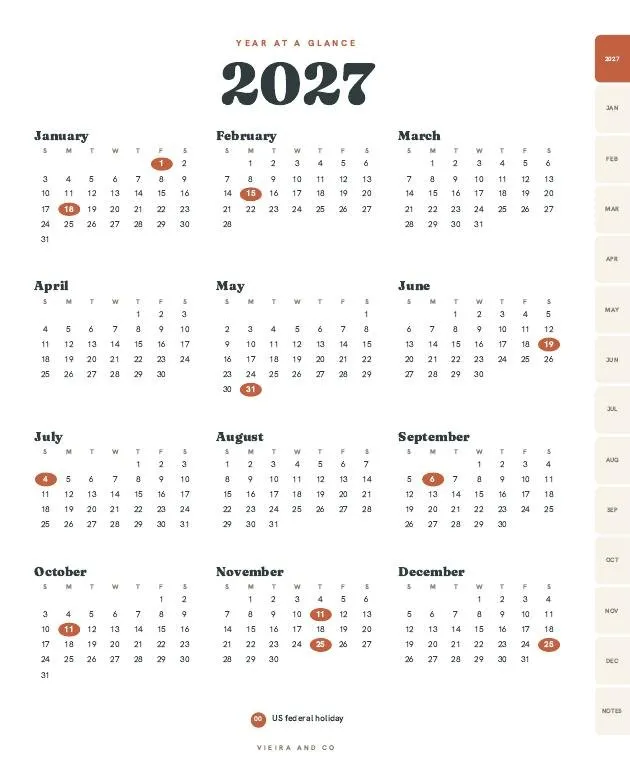
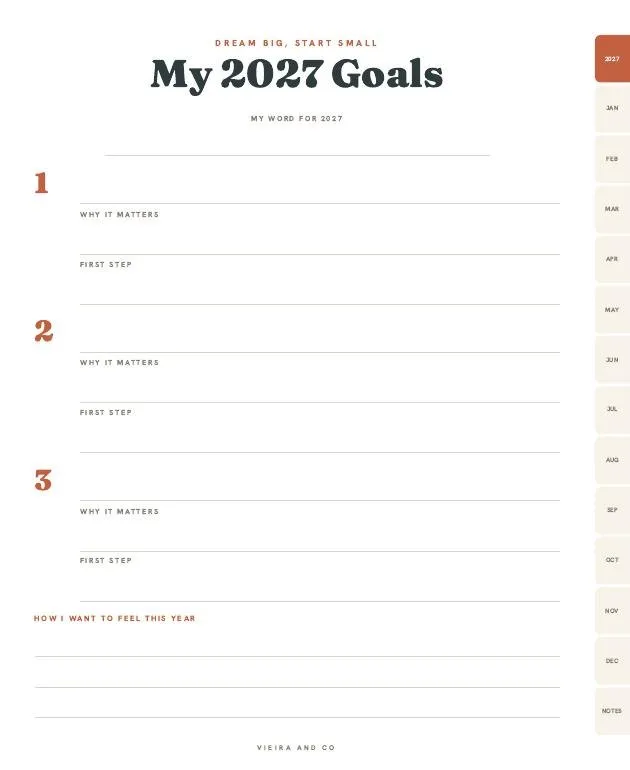
A look inside the 2027 planner
Real pages from our planner: the cover, the year at a glance and the goals page.
Cover
What to do when you slip
You will miss days. Everyone does. What matters is what happens next.
- Never miss twice. One skipped day is a blip. Aim to get back on track the very next day.
- Shrink the goal instead of dropping it. Can’t do 30 minutes? Do five. A smaller version keeps the habit alive.
- Look for the cause. Were you tired, too busy, missing something you needed? Fix the obstacle, not your character.
- Restart on any day. You don’t have to wait for a Monday, a new month or next January. Today counts.
- Change the goal if it’s wrong. Sometimes you learn by March that a goal doesn’t fit your life. Adjusting it is planning, not failing.
New year goals ideas by life area
If you’re stuck, here are some ideas to get started. Pick what speaks to you and make it specific.
Health and energy
- Walk after dinner three times a week
- Go to bed 30 minutes earlier on weeknights
- Cook at home one more night a week
- Book the checkups you’ve been putting off
Home
- Clear one drawer or shelf every weekend in January
- Start a small herb garden
- Finish one long-delayed home project
Money
- Write down a monthly spending plan
- Set up an automatic transfer to savings, even a small one
- Review your subscriptions every three months
For bigger money decisions, it’s worth talking to a qualified financial professional.
Relationships
- Have a standing call with a friend or relative
- Plan one family day a month with no screens
- Write a few handwritten notes a year
Learning and fun
- Read one book a month
- Learn ten recipes from another country
- Take a class in something you’ve always been curious about
- Visit three places within a day’s drive that you’ve never seen
Work and growth
- Finish a course or certification
- Update your resume twice a year
- Keep a list of your wins as they happen
Make it a new year goals journal
You don’t need a fancy system. A notebook or a few planner pages with your look-back answers, your three goals, a monthly plan and a weekly check-in is enough to act as a new year goals journal. Open it once a week, write a few lines, and at the end of 2027 you’ll have a record of the year in your own words.
Pin the year at a glance somewhere you’ll see it every day, like a printed calendar on the fridge, so birthdays, trips and busy weeks don’t sneak up on your plans.
Printables for this
2027 planner
Weekly and monthly pages, habit tracker and goals, printable or GoodNotes.

2027 printable calendar
Year at a glance and monthly pages with US holidays.