Activities for seniors: simple ideas for fun and connection
How to pick the right activity for the person in front of you, and how to tell when it's time to change course.
By Vieira and Co. 5 minute read. November 2026.
Written with AI assistance and fact-checked by Vieira and Co. How we make our content
The best activities for seniors are rarely the most elaborate. A good one fits the person’s ability and mood that day, gives them a small win, and leaves room to talk. Whether you are a family member planning a visit or an activity director filling a calendar, these ideas will help you choose well and adapt as you go.
Start with the person, not the activity
Before you pick anything, take a quick read of who you are with.
- Ability. Can they read standard print? Use their hands easily? Follow a few steps in a row? Stay seated for 30 minutes?
- Mood and energy. Most people have a time of day when they feel their best. Learn it and plan around it. A tired or unsettled moment calls for something calm and familiar.
- History. A former teacher may love word games. A lifelong gardener may light up sorting seed packets. Past jobs, hobbies and hometowns are your best guide.
- Preference. Some people love a crowd. Others are happier one-to-one. Both are fine.
A simple rule: aim for success most of the time. If an activity feels like a test, it stops being fun. If it’s too easy, it can feel childish. Adults should always be treated as adults.
Ideas grouped by type
- ReminiscenceConversation prompts, old photos, familiar objects and "what did it cost back then" questions.
- Words and numbersFinish the saying, word pairs, categories, large-print word searches and simple trivia.
- Music and movementSing-alongs, guess the decade, seated stretching and gentle ball or balloon games.
- Creative and purposefulPainting, flower arranging, folding towels, sorting buttons, setting a table.
Reminiscence
Reminiscence activities invite people to share stories from their own lives. There are no wrong answers, which often makes them a good fit for activities for seniors with memory loss: nobody has to recall a recent detail or get anything right.
- Conversation cards. “Tell me about your first car” or “What did you do on summer evenings as a kid?”
- Photo albums. Their own, or general photos of the era they grew up in.
- Memory boxes. Fabric swatches, kitchen tools, old postcards and other objects to hold and talk about.
- Then and now. Compare prices, gadgets or school days with today.
Word and number games
- Finish the saying. Start a familiar phrase and let the group complete it.
- Word pairs. “Salt and…” “Bread and…”
- Name three. Three flowers, three things in a kitchen, three states that start with M.
- Odd one out. Four words, one doesn’t belong.
- Large-print word searches and simple trivia, with answers read aloud at the end.
Music and movement
Music is often one of the most loved activities in any group.
- Sing-alongs of songs from their teens and twenties.
- Guess the decade from a short clip.
- Seated movement. Arm circles, toe taps or passing a soft ball around the circle.
- Balloon volley, played seated. Gentle and full of laughter. Check for latex allergies first, or use a soft beach ball.
If anyone has mobility concerns, check with their care team before starting any exercise program.
Creative activities
- Watercolor painting with big brushes
- Flower arranging with real or silk flowers
- Simple collage from magazines
- Planting herbs in small pots
- Decorating cards for family or holidays
Focus on the process, not a perfect result.
Everyday tasks with purpose
For many people, feeling useful matters more than being entertained. These familiar tasks can be calming and give a real sense of contribution.
- Folding laundry or napkins
- Sorting buttons, coins or silverware
- Matching socks
- Watering plants
- Helping set the table or wipe it down
- Rolling yarn into balls
Let them do it their way. A slightly uneven stack of towels is still a job well done. For anyone with advanced dementia, skip small items like buttons and coins that could be put in the mouth, and ask their care team what’s suitable.
Adapting for low vision or hearing
Small changes make a big difference.
For low vision:
- Use large print, high contrast (black on white or cream), and plain fonts.
- Make sure the room is well lit without glare from windows.
- Read questions aloud as well as showing them.
- Choose tactile options: textured objects, cards to hold, items to sort by feel.
For hearing loss:
- Sit face to face, at eye level, in good light so they can see your face.
- Turn off the TV and background music during games.
- Speak clearly and a little slower, without shouting.
- Write key words or show a card alongside spoken questions.
- Keep groups small so fewer voices compete.
Group or one-to-one?
Groups bring energy, laughter and a sense of belonging. They often work well with a smaller circle of around 6 to 12 people, a clear leader, seats in a circle and activities where everyone can join at their own level.
One-to-one time suits quieter people, anyone easily overwhelmed, or someone with advanced memory loss. It allows a slower pace and deeper conversation. Often, a mix of both across the week works well.
Tips for family visitors
- Bring something to do. A photo album, a deck of cards or a short list of questions takes the pressure off conversation.
- Keep it short and warm. Twenty good minutes beat two tired hours.
- Follow their lead. If they want to tell the same story again, listen as if it’s new.
- Don’t quiz. “Do you remember who this is?” can feel like a test. Try “This is Aunt Rose at the lake. I love this picture.”
- End on a high note, before anyone gets tired.
Tips for activity directors
- Plan a mix of reminiscence, word games, music and purposeful tasks across the week.
- Have an easier and harder version of each activity ready so everyone can join.
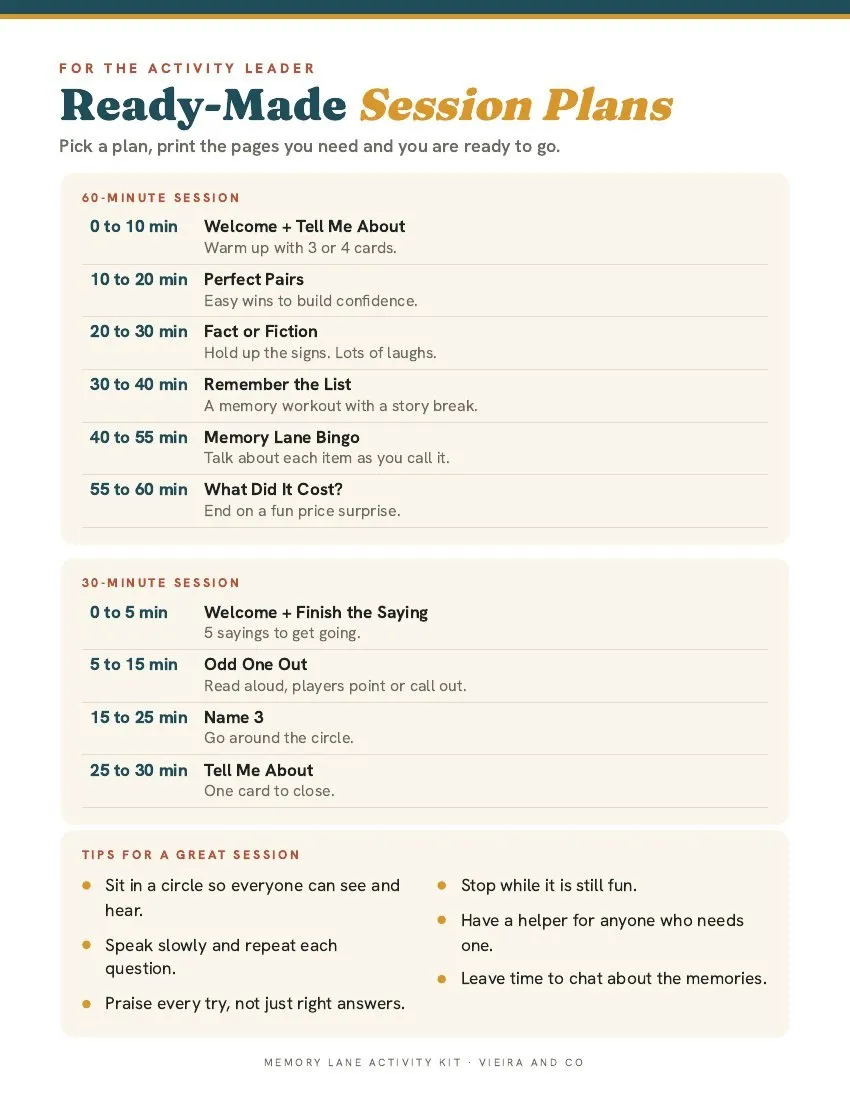
- Use a simple structure: a warm-up, the main activity, a closing chat.
- Praise every try, not only correct answers.
- Keep notes on what each person enjoyed, and share them with staff and families.
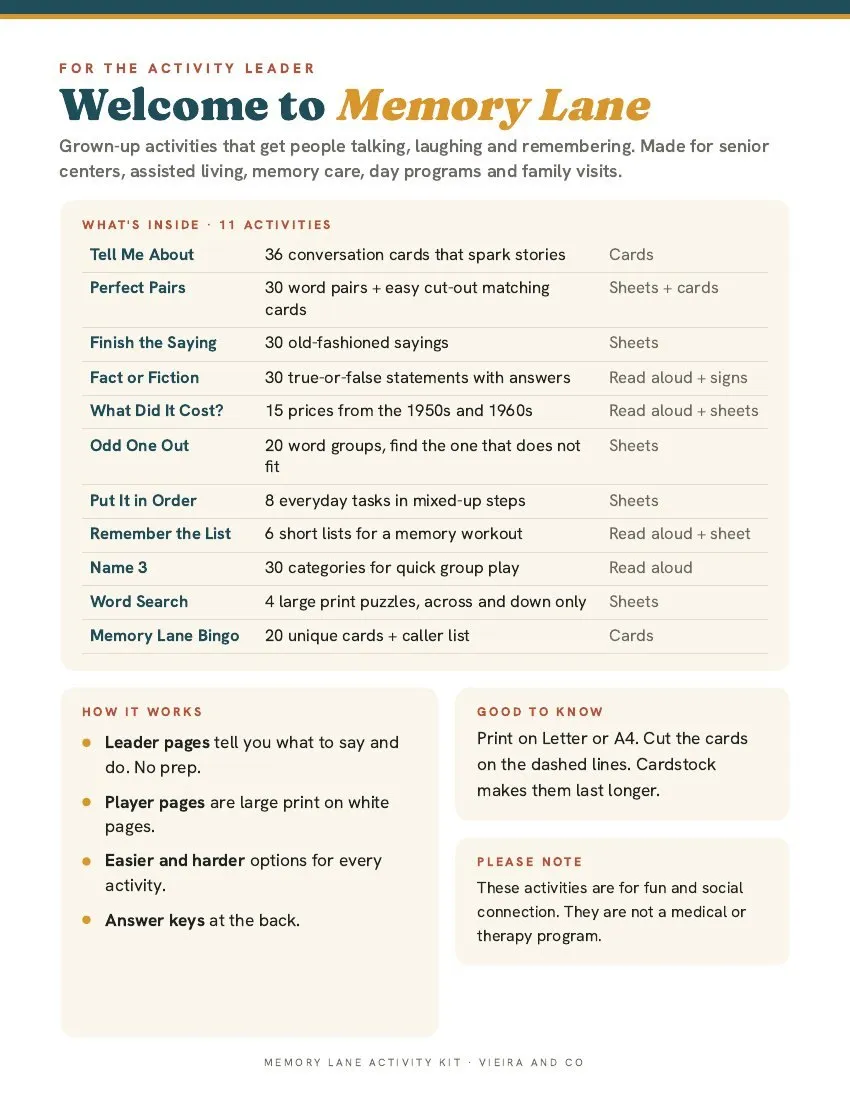
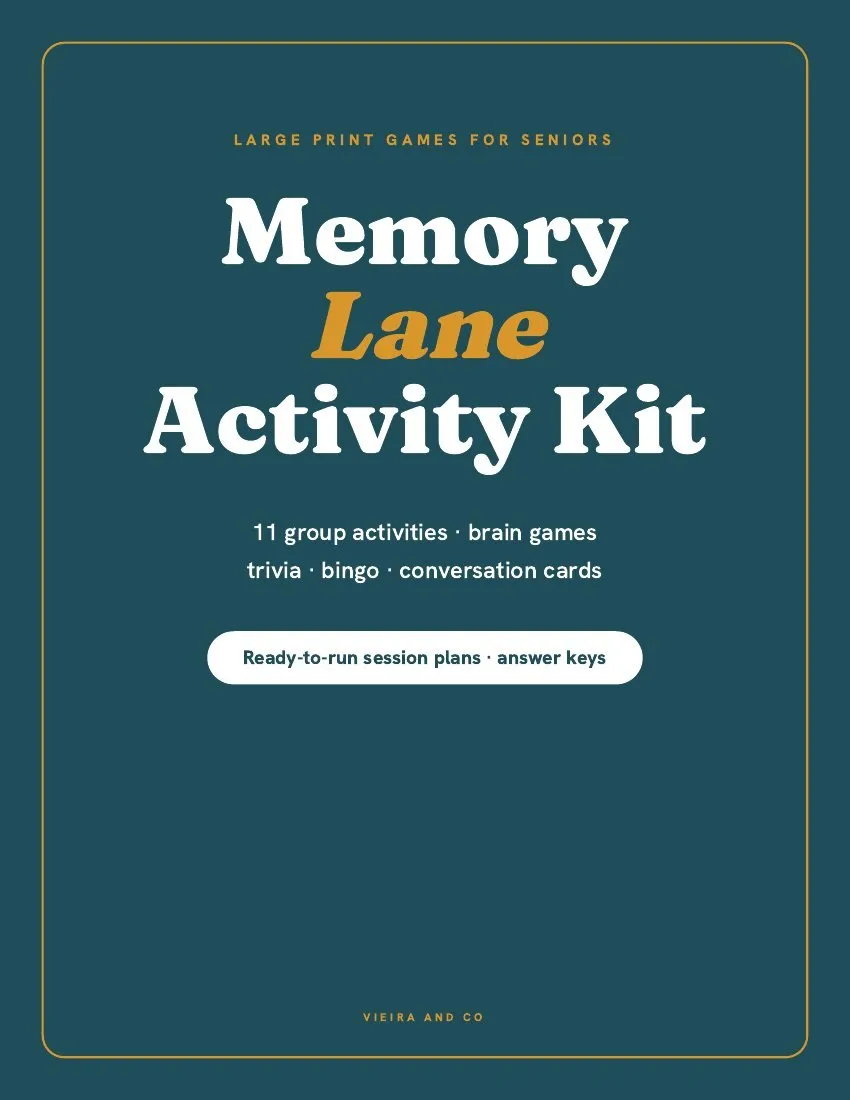
If you want to skip the prep, our Memory Lane activity kit has large-print memory games, bingo and trivia made with activity directors in mind.
Signs to stop or change the activity
Watch faces and body language more than the clock. It’s time to slow down, switch or stop if you notice:
- Frustration, agitation or repeated “I can’t”
- Restlessness, fidgeting or trying to leave
- Withdrawal, staring away or no response
- Signs of tiredness: yawning, drooping, slumping in the chair
- Confusion that grows rather than eases
Switch to something calmer and more familiar, take a break with a drink and snack, or simply sit together quietly. If you notice ongoing changes in mood, memory or behavior, especially with someone living with dementia, share what you’ve seen with their doctor or care team.
Stop while it's still fun.
Ending a few minutes early, on a laugh, leaves everyone looking forward to next time.
This article is general information. It isn't legal, medical or financial advice. For wills, powers of attorney, health or benefits, talk to a qualified professional.